


What to Expect During Mold Removal: Process, Containment, and Follow-Up

Direct Answer
During mold removal, expect containment setup first, then physical removal and disposal of mold-contaminated porous materials, followed by antimicrobial cleaning of remaining surfaces and HEPA vacuuming. The process typically takes 1–2 days for a small contained area to a week or more for larger contamination. You should not enter the containment area without proper PPE, should not attempt to clean mold yourself, and should not remove containment until the work is complete and verified. After removal, the property is ready for full remediation including moisture correction and post-remediation verification. 911 Mitigation Inc. guides South Florida property owners through each step.
Table of Contents
What to Do Before Mold Removal Begins
Before the mold removal crew arrives, there are several steps that protect both your safety and the effectiveness of the removal:
- Do not enter the affected area without proper PPE — disturbing mold releases spores into the air.
- Do not attempt to clean the mold yourself. Household cleaners and bleach are ineffective on porous materials and can spread spores. See our mold remediation page for why professional removal matters.
- Do not run the HVAC system if mold is present in or around the ductwork — running it distributes spores throughout the property.
- Contact your insurance company to determine whether the mold removal is covered under your policy, particularly if it resulted from a covered water damage event.
- Schedule a mold inspection if one has not already been performed, to define the scope and identify the moisture source.
- Secure valuables and documents in unaffected areas, and remove any items that could be damaged by containment or the removal process.
These steps matter because they protect your health and prevent the contamination from spreading. Mold spores are easily aerosolized — even walking through an affected area can stir up millions of spores. The HVAC system is particularly important: if mold is present in the ductwork, running the system distributes spores throughout the property, expanding the contamination and the eventual remediation scope.
Containment Setup
The first step on site is containment setup. The crew isolates the work area from the rest of the property using polyethylene sheeting sealed at all edges, creating a physical barrier that prevents spores from migrating into unaffected areas. A negative air machine — a HEPA-filtered exhaust unit — is installed to maintain negative air pressure within the containment, meaning air flows into the containment from outside but cannot escape outward. This keeps any airborne spores generated during the removal within the containment zone, where they are captured by the HEPA filter.
The containment remains in place throughout the removal process. Access is controlled — typically through a zipper entry or an airlock — and all personnel entering the containment wear appropriate PPE. The crew also establishes a decontamination protocol for entering and exiting the containment, preventing spores from being carried out on clothing or equipment. This is why professional mold removal is a multi-day process: the containment must be maintained, the removal must be methodical, and the disposal must be controlled.
Material Removal and Disposal
Once the containment is established, the crew physically removes mold-contaminated porous materials. Drywall with visible mold growth is cut out and removed. Insulation behind contaminated drywall is removed — insulation cannot be effectively cleaned and must be replaced. Carpet and padding that are contaminated are pulled up, bagged, and disposed of. Wood framing with surface mold may be cleaned if the growth is superficial, but heavily colonized or structurally compromised framing may require replacement.
All removed materials are bagged in 6-mil polyethylene bags while still within the containment, sealed, and disposed of according to applicable protocols. Bagging under containment — rather than carrying contaminated materials through the property — is essential to prevent spreading spores into unaffected areas during disposal. The crew documents the materials removed and the conditions found, creating a record for your insurance claim and for the post-remediation verification.
Surface Cleaning and HEPA Vacuuming
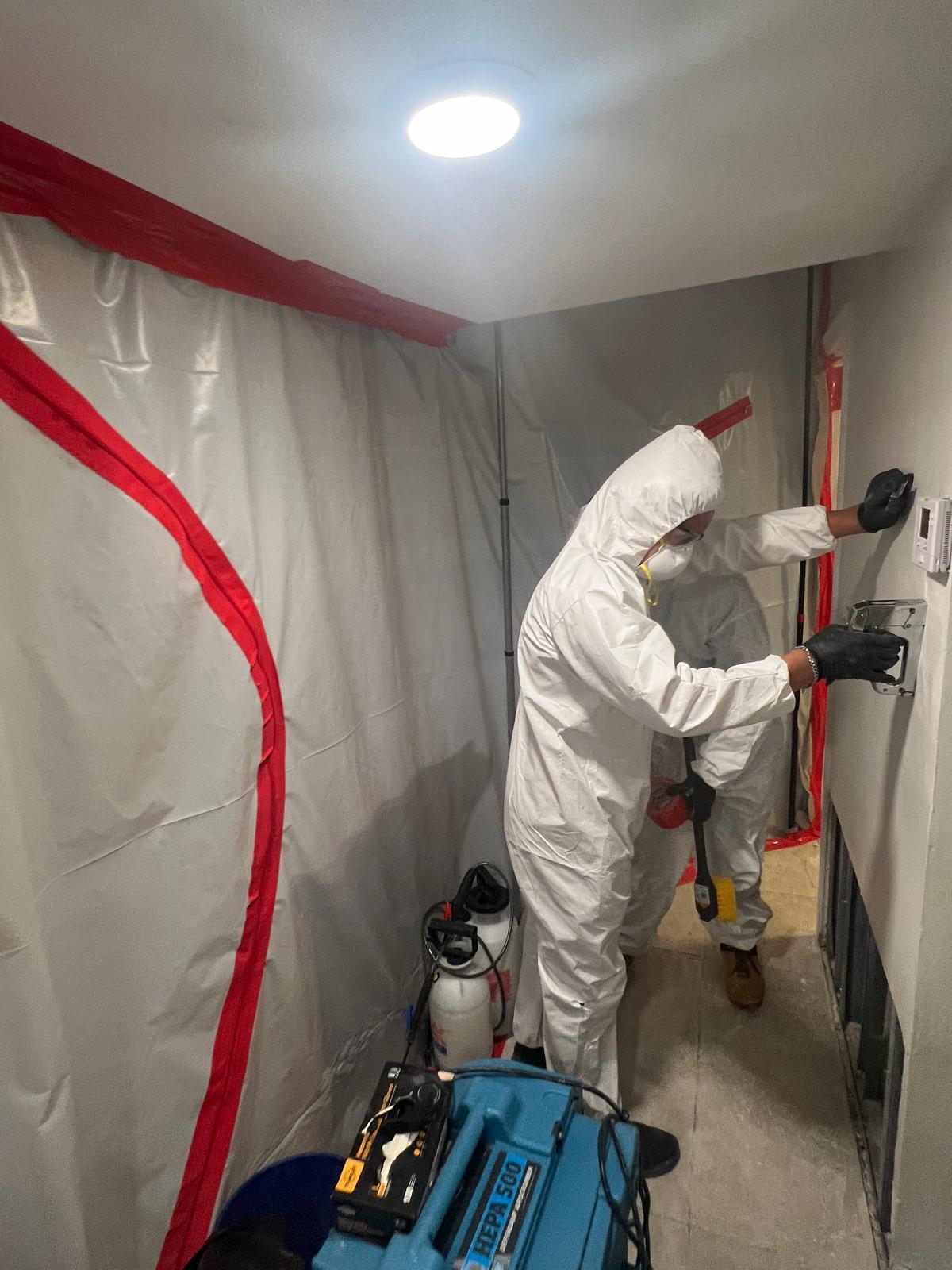
After contaminated materials are removed, the remaining surfaces — wood framing, concrete, metal, and other non-porous or semi-porous materials — are cleaned with appropriate antimicrobial agents. This treatment addresses any residual mold on surfaces that will remain. The cleaned surfaces are then HEPA-vacuumed to remove any settled spores, and the entire containment interior is wiped down and vacuumed to capture spores that settled during the removal process.
If the mold contamination involved the HVAC system — either through growth in the ductwork or because the system was running and distributed spores — the ductwork and components are also cleaned. This is essential because without HVAC cleaning, the system would re-distribute any residual spores throughout the property each time it operates. See our water damage restoration page for related moisture considerations, as mold and water damage frequently coexist.
What to Avoid During Mold Removal
Several common actions can interfere with the mold removal process or create additional risks:
- Do not enter the containment area without PPE — mold spores within the containment are concentrated and pose inhalation risks.
- Do not attempt to clean mold yourself with bleach or household products — this is ineffective on porous materials and disperses spores into the air.
- Do not run the HVAC during or before removal if mold is present in the system — it spreads spores throughout the property.
- Do not remove containment barriers — they are essential for preventing spore migration into unaffected areas.
- Do not discard removed materials outside the containment protocol — they must be bagged and disposed of under controlled conditions.
- Do not delay removal after discovering mold — the colony continues to grow and release spores, increasing the scope and cost.
Following these guidelines protects your health and the effectiveness of the removal. Mold spores can cause respiratory symptoms in sensitive individuals, and disturbing mold without proper containment and PPE creates exposure risks for occupants throughout the property.
After Removal: What Comes Next
After mold removal is complete, the property is ready for the remaining phases of full mold remediation:
- Moisture correction: The moisture source that allowed the mold to grow is identified and corrected — a leak repair, plumbing fix, or dehumidification to address elevated humidity.
- Structural drying: Any remaining moisture in building materials is brought to target levels. See structural drying.
- Reconstruction: Removed drywall, insulation, and flooring are replaced — see drywall restoration.
- Post-remediation verification: Clearance testing confirms the mold was successfully removed and the environment has returned to normal fungal ecology.
Throughout, 911 Mitigation Inc. serves as your single point of contact so the phases connect without gaps. If the mold resulted from water damage or storm-related water intrusion, the water damage restoration and drying scope is coordinated alongside the mold removal. The documentation from the removal phase — materials removed, conditions found, containment protocols used — carries forward to the verification and reconstruction teams.
Frequently Asked Questions
How long does mold removal take?
It depends on the extent of contamination. A small contained area may take 1–2 days, while larger projects spanning multiple rooms or floors can take a week or more.
Can I stay in my home during mold removal?
For small contained areas, sometimes. For larger projects or when the HVAC is affected, it may be necessary to vacate the property. We advise based on the scope.
Should I run my HVAC during mold removal?
No, not if mold is present in or around the system. Running it distributes spores throughout the property. The system should be cleaned as part of the removal if contaminated.
Why can't I just bleach the mold myself?
Bleach is ineffective on porous materials like drywall and insulation, and disturbing mold without containment disperses spores into the air. Professional removal uses containment, HEPA filtration, and proper disposal.
Will the mold come back after removal?
If the moisture source is corrected and the area is kept dry, mold should not return. Without moisture correction, the mold will return — which is why full remediation includes fixing the source.
Do I need separate companies for removal and verification?
Not necessarily. We can handle the full process, though some prefer an independent third-party verification for objectivity. We can coordinate with independent assessors.
What documentation do you provide for my insurance?
We document the materials removed, conditions found, containment protocols used, and the scope of work — supporting your claim and the verification process.
Preparing for Mold Removal?
Call 786-334-4981 — we walk you through what to expect, what to avoid, and the full sequence from removal through remediation and verification.